
GAMSTOP, self-exclusion and what changes when a site is outside it
 Available in GB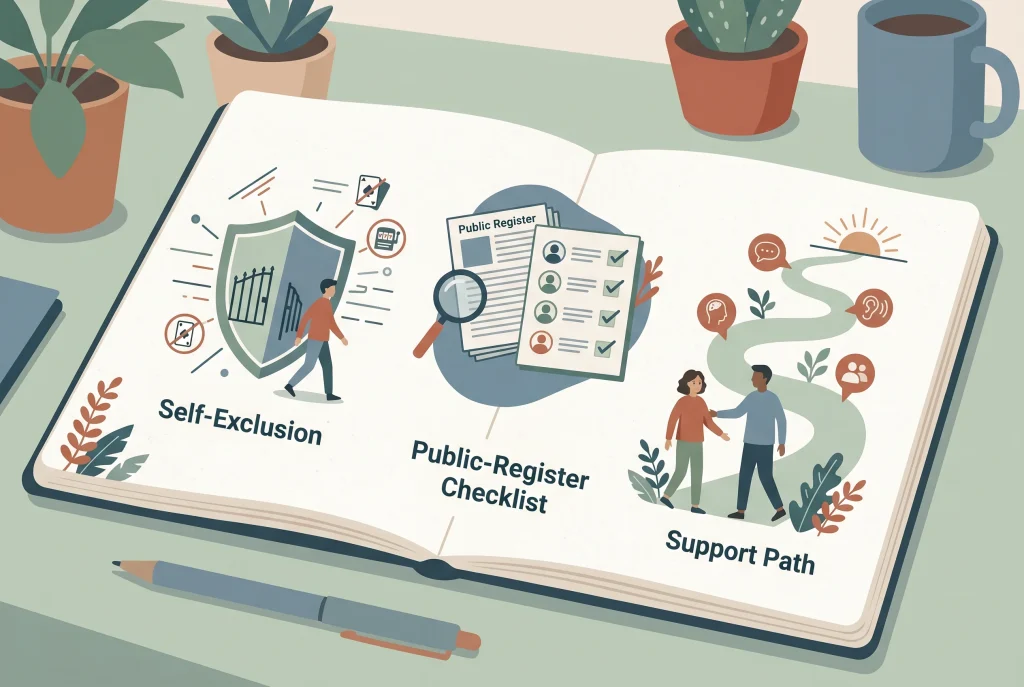
The phrase “not on GAMSTOP” can sound like a simple product label. For a person in Great Britain, it is better understood as a protection issue. GAMSTOP is the online multi-operator self-exclusion service used by relevant remote gambling businesses licensed in Great Britain. When a person is registered for an exclusion period, the service is designed to stop them gambling with participating licensed websites and apps for that period.
A site outside that coverage should not be treated as a clever shortcut or a special feature. It may mean the usual Great Britain self-exclusion layer is missing. That matters most when the reader is already excluded, has set limits, has turned on a bank block, or feels pulled towards gambling at a time when they are trying to stop. This page explains the boundary in practical terms and points to safer next steps, without listing gambling sites or helping anyone work around a protection they chose.
The wider picture is in our guide to what UK players should check.
What GAMSTOP actually covers
GAMSTOP is a free online self-exclusion service. The core point is simple: once a person has registered, it blocks them from gambling with online gambling companies licensed in Great Britain for the selected exclusion period. Official GAMSTOP information describes exclusion periods that include six months, one year, five years, and five years with auto-renewal. During the minimum period, early cancellation is not available.
That last detail is important because self-exclusion works best when it removes the need to make the same decision again in a difficult moment. It is not meant to be a flexible spending control that can be switched off when an urge appears. It is a boundary set in advance, usually because ordinary limits, promises to oneself or short breaks have not been enough.
Relevant Great Britain licensed remote gambling businesses must participate in the national multi-operator self-exclusion scheme. That is why a “not on GAMSTOP” claim changes the nature of the decision. The issue is not whether a website has attractive games or a convenient sign-up form. The issue is whether a person is stepping outside a protection layer that exists for a reason.
Why “outside GAMSTOP” is not a neutral detail
For someone who is not excluded and is only trying to understand the language, the safest reading is still cautious: a site’s relationship with GAMSTOP says something about the protections around the account. It does not prove the site is fair, safe, licensed for Great Britain or suitable for a particular person. Those checks sit on other pages, especially the Gambling Commission public register and the terms that explain money, identity checks and withdrawals.
For someone who is currently self-excluded, the picture is much sharper. Looking for a place that does not apply the block can be a sign that the protective boundary is being tested. That does not make the person weak or bad. It does mean the next step should be support-led rather than gambling-led. The useful question is not “Which site lets me continue?” but “What control can I reinforce before I send money or documents?”
GAMSTOP also makes clear that it cannot stop access to organisations that do not participate. That limitation should not be turned into a how-to route. It is a reason to add layers: blocking software, bank gambling blocks, safer account settings, and help from a recognised gambling support service when the urge feels hard to manage alone.
Decision path: why are you reading about this?
| Reader situation | What it may mean | Safer next step | Where to check or get support |
|---|---|---|---|
| You are only trying to understand the phrase | You may need a plain explanation before comparing any claim made by a gambling site. | Treat “outside GAMSTOP” as a protection warning, then check licence status before considering money or documents. | Use the Gambling Commission public register for licence details and the official GAMSTOP site for self-exclusion information. |
| You are already self-excluded | The moment may involve pressure to undo a boundary that was set to protect you. | Do not deposit. Reinforce the block, step away from the device, and contact a support service if the urge feels urgent. | GAMSTOP support pages, GamCare, the National Gambling Helpline, blocking software and bank gambling blocks can all be relevant. |
| You have a bank block or account limit | A payment restriction may be doing exactly what it was designed to do. | Keep the block in place. If you are trying to get around it, treat that as a warning sign rather than a technical problem. | Your bank’s gambling-block controls, Gambling Commission guidance on transaction blocks, and gambling support services. |
| You are worried about a site that says it is not covered | The site may sit outside familiar Great Britain protections, or it may be making claims you cannot verify. | Stop before uploading documents. Compare the domain, trading name and licence details against official information. | Use the licence-check page on this site as your next step, then consider document and data safety if anything looks inconsistent. |
What this page will not help you do
This guide does not list gambling businesses outside GAMSTOP, does not rate them, and does not describe ways to keep playing while a block is active. That boundary is intentional. A page about self-exclusion should not become a tool for weakening self-exclusion.
It also does not decide whether a specific website is lawful, fair or suitable. A licence check can reduce avoidable risk, but it is not a promise that gambling is safe for the individual reader. A business can display technical information, terms and a licence link, yet the person reading may still be in a situation where gambling would make harm more likely.
Finally, this page does not replace a conversation with a support worker, adviser or trusted person. If the real problem is that gambling feels difficult to stop, the most useful step is often practical and immediate: close the page, avoid depositing, put another barrier in place, and speak to someone before the urge has time to build.
How layered controls fit together
Self-exclusion is one layer, not the only layer. Blocking software can make gambling websites harder to reach. Bank gambling blocks can stop many card or account transactions connected with gambling. Account limits can reduce exposure on sites where a person still has access. Support services can help the person think through patterns, debt pressure, secrecy, stress or repeated attempts to restart.
The layers are useful because gambling harm rarely appears as one neat problem. It can be emotional, financial, practical and social at the same time. A person may be fine on some days and vulnerable on others. A layered approach reduces the number of decisions that have to be made during the vulnerable moments.
If a site markets itself by suggesting that blocks, checks or limits are easy to avoid, that should be read as a warning. A safer gambling environment does not rely on secrecy, pressure or urgency. It should make licence status, terms, identity checks, customer-funds information and support routes easy to understand before any money is sent.
Common misunderstandings
Does “not on GAMSTOP” mean a site is illegal?Can GAMSTOP be cancelled early?Should I upload documents to a site that is outside GAMSTOP?
Safer next steps
- If you are self-excluded or trying to avoid gambling, use support first rather than looking for a new account.
- If you are only checking claims, compare any licence statement with the Gambling Commission public register before sending money or documents.
- If you have a bank gambling block, keep it in place and add other controls instead of trying to get around it.
- If you feel at risk of harm today, contact a recognised gambling support service such as GamCare or the National Gambling Helpline through their official pages.
The main practical lesson is that GAMSTOP is not just a name in a site description. It is a protection boundary. When that boundary is missing, treat the decision as higher risk and slow down before you act.
Practical tools and helplines are listed under gambling support and blocks.
Read next
- Check the licence and register entry
- Support and blocking options
- Money and payment risks to check
- Back to the main guide