
Payments, bank blocks and customer-funds checks for online gambling
 Available in GB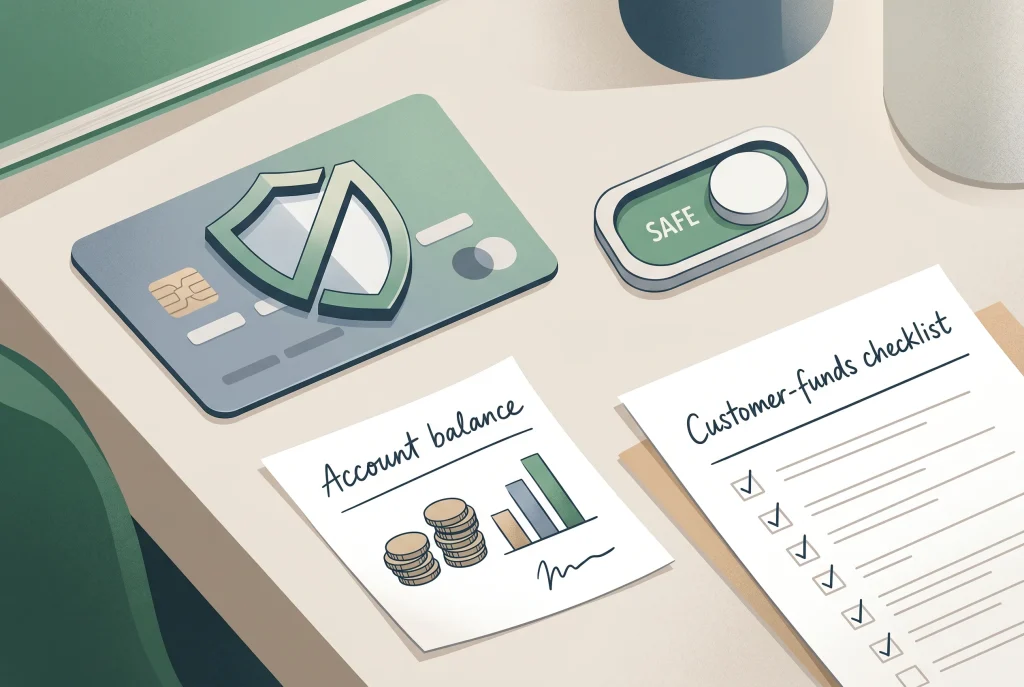
Money details can look like small print, but they often reveal the biggest practical risks. Before depositing with any online gambling site, a Great Britain consumer should understand what payment claims mean, what protective bank blocks are for, and how customer money is described in the terms. This is especially important when a site is described as outside GAMSTOP, because the same decision may involve both financial risk and weaker self-exclusion protection.
This page does not rank payment methods, promise withdrawal speeds, compare gambling businesses or describe ways to get around a block. It focuses on checks that can be made before money leaves your account: credit-card warnings, e-wallet caveats, customer-funds protection wording, bank gambling blocks and record-keeping.
The wider picture is in our guide to what UK players should check.
Start with the payment claim, not the payment button
A gambling site may make deposits look quick and ordinary. The safer question is what the payment route tells you about the environment around the account. In the Great Britain regulated context described by the Gambling Commission, gambling businesses must not accept credit-card payments for gambling. Guidance also covers e-wallets, where providers are expected to prevent credit cards or credit-card funds from being used for gambling payments.
That means a claim that encourages credit-card gambling, borrowed-money gambling or a simple workaround should be treated as a warning sign. It is not a premium feature. It suggests the site may be pushing the reader towards riskier funding behaviour or sitting outside familiar safeguards.
E-wallets need careful reading too. An e-wallet may be convenient, but convenience is not the same as safety. Check whether the payment route is clearly named, whether the site explains fees or limits, whether the account holder name matches, and whether withdrawals must return to the same method. Do not assume that an e-wallet removes the need for identity checks, affordability checks or source-of-funds questions.
Bank gambling blocks are protection, not a problem to solve
Many banks offer gambling blocks for bank accounts or debit cards. Official and support pages describe them as practical protective controls. They are most useful when they are treated as a boundary, not as an inconvenience to be worked around.
If you have turned on a bank gambling block and then find yourself looking for a way to deposit elsewhere, pause before taking action. That moment says something important: the block may be doing the job you asked it to do. Trying to get around a block, gambling with borrowed money, or hiding transactions from someone who helps you manage finances can all be warning signs that support would be more useful than another payment option.
Blocks can vary by bank, and individual banks may have their own cooling-off periods or settings. The safest public advice is not to guess those details. Check your own bank’s official information and use the block as part of a wider plan with self-exclusion, blocking software and support if gambling feels hard to stop.
Risk map: money signal, why it matters and what to check
| Money signal | Why it matters | What to check before continuing | Safer response |
|---|---|---|---|
| Credit-card deposit claim | Credit-card gambling is not accepted by licensed gambling businesses in the Great Britain context described by the regulator. | Check whether the claim conflicts with Gambling Commission guidance and whether the site is properly licensed for Great Britain. | Do not treat it as a benefit. Stop and verify the licence position before sharing any payment details. |
| E-wallet payment route | E-wallets can still involve rules about funding source, account holder name, withdrawals, fees and checks. | Read the terms for permitted payment methods, withdrawal return route, identity checks and any third-party payment restrictions. | Keep records and avoid assuming speed, anonymity or easier withdrawals. |
| Active bank gambling block | The block may be a protective barrier chosen during a calmer moment. | Check your bank’s official block information and ask why you feel pressure to override the barrier. | Keep the block in place and use support or blocking tools if the urge is strong. |
| Customer-funds wording | Money left in an account may have different levels of protection if a company becomes insolvent. | Look for the customer-funds section in the terms, including the stated protection level. | Avoid leaving more money than you can afford to lose access to, and do not rely on vague reassurance. |
| Missing or unclear withdrawal route | Unclear withdrawal information can make later disputes harder to resolve. | Check withdrawal method, account holder rules, document requirements and complaints process before depositing. | Save terms and messages before funding the account. If delayed later, ask for the stated reason in writing. |
Customer funds: what the wording is trying to tell you
Customer funds can include deposits, winnings owed or left in an account, and bonus money that a person has become entitled to under the terms. Official guidance also makes an important distinction: open bets are not treated in the same way for insolvency protection arrangements. The terms should state the level of protection applied to customer money.
The phrase “not protected” has a plain practical meaning. If money is not protected, it would likely be lost if the company became insolvent. That does not mean every company will fail, and it does not prove a site is unsafe on its own. It does mean an account balance is not the same as money sitting securely in a bank account.
Before depositing, read the customer-funds section slowly. Look for whether the business says funds are not protected, medium protected or given a higher level of protection. Do not turn the rating into a promise. The regulator also explains that it does not monitor companies’ financial health directly in real time. The useful behaviour is to understand the wording and avoid keeping unnecessary balances in a gambling account.
Record-keeping before and after a deposit
If you decide to continue after checking the licence and terms, keep records from the beginning. Save the payment method used, time and date of deposit, terms that applied at the time, any bonus or wagering restriction you accepted, and messages from customer support. If a later withdrawal is delayed, these records are easier to collect before stress takes over.
Good records do not guarantee a positive outcome, but they reduce confusion. They help you ask focused questions: What is the stated reason for the delay? Which document is being requested? Which term is being relied on? Has the company explained the complaint route? Those questions belong on the ID and withdrawals page, but the habit starts at the payment stage.
Do not use another person’s payment method unless the terms clearly permit it and the account holder understands the implications. Third-party payment issues can create identity and withdrawal problems later. Do not use false details. If a site appears to encourage blurred identities, anonymous payment promises or rushed funding, that should make you stop rather than continue.
What payment pages cannot prove
A smooth payment page cannot prove that a gambling site is licensed for Great Britain, that withdrawals will be fast, that identity checks will be simple, or that a bonus will be easy to clear. A long list of deposit icons can be marketing decoration rather than meaningful evidence. Payment availability can also change, so public guidance should not promise that a named method is accepted or better.
The same caution applies to fees, limits and payout times. Unless those details are visible in the current terms of the specific business, they should not be treated as facts. If the terms are vague, you should not fill the gap with assumptions. Ask before depositing or, if the answer remains unclear, do not fund the account.
Payment safety also cannot answer a personal control question. A transaction may be technically possible while still being harmful for the person making it. If the deposit is connected to an active self-exclusion, a bank block, debt pressure or the feeling that you must win money back, the safer next step is to pause and use support.
A practical pre-deposit money checklist
- Check the Gambling Commission public register before treating any payment option as legitimate for Great Britain.
- Read the payment, withdrawal and customer-funds sections of the terms before depositing.
- Do not use credit-card claims, borrowed-money framing or anonymity promises as reasons to continue.
- Keep bank gambling blocks in place if you set them to reduce harm.
- Save screenshots of key terms and transaction records before a dispute happens.
- Move to the ID and withdrawals guide if a withdrawal is delayed or a document request appears.
The safest money decision is often the one made before any money moves. If the payment route, licence position or customer-funds wording is unclear, waiting is not overcautious. It is the only point at which you still have full control of the funds.
Support when payment pressure is the real issue
Trying to get around a bank block, gambling with borrowed money, or depositing because you feel you must recover losses are all reasons to stop and get support. That support can be practical rather than dramatic: gambling support services, bank controls, blocking software, a trusted person, and money advice can all reduce the pressure while the situation is still manageable.
This is not about shame. It is about recognising when a payment decision has stopped being ordinary. A gambling site may make the next deposit feel easy, but a protective pause is often the better financial decision.
Payment trouble usually surfaces at ID checks and withdrawal delays.
Read next
- ID checks and delayed withdrawals
- Bonus restrictions that affect withdrawals
- Bank blocks and other protective tools
- Back to the main guide