
Bonus terms and withdrawal restrictions: what to read before accepting an offer
 Available in GB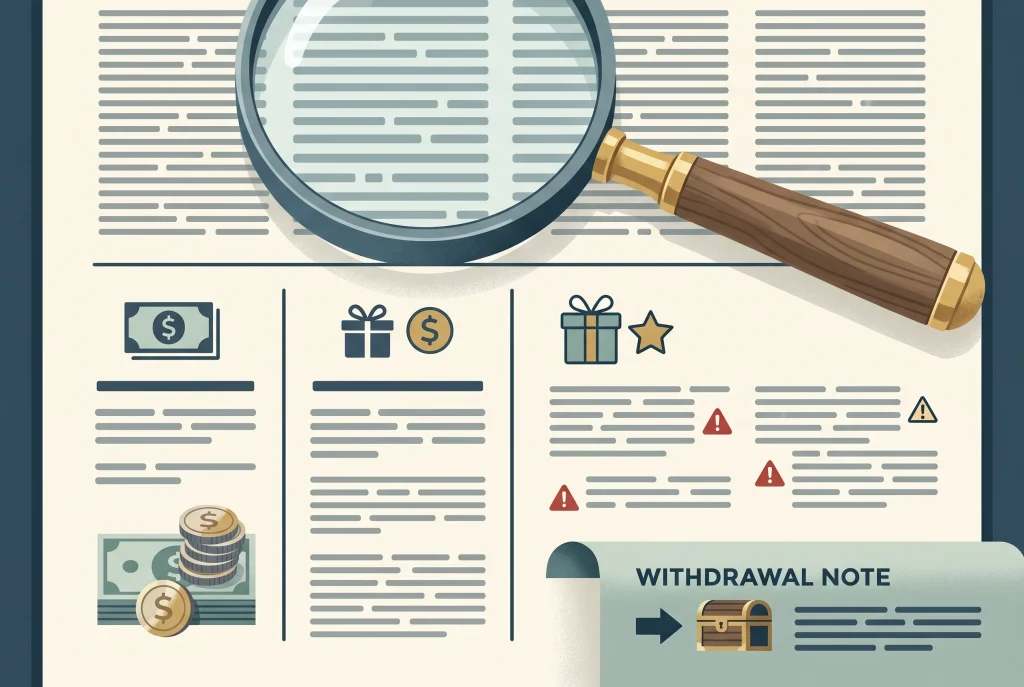
A headline offer can make a gambling site look more attractive than it really is. The number in the banner is rarely the important part. What matters is the restriction attached to the offer: what counts as bonus money, what happens to your own deposit, when winnings can be withdrawn, and what rule the business may rely on if a dispute starts later.
This page does not compare offers, promote large bonuses or claim that a promotion makes a gambling site trustworthy. It explains how to read the terms before accepting anything. That is especially important when a site is outside GAMSTOP coverage or makes bold claims about easy play, because a promotion can pull attention away from licensing, account checks and personal control.
The wider picture is in our guide to what UK players should check.
Read the restrictions before accepting
Official guidance tells customers to check restrictions before accepting gambling bonuses. That may sound obvious, but promotions are often presented at the exact point where the customer is being encouraged to deposit quickly. A safer approach is to pause before clicking accept and read the terms as if you may need to explain them during a later withdrawal dispute.
Look for the terms that apply to your own deposited money, bonus funds, winnings from bonus play, game restrictions, time limits, maximum withdrawal wording, identity checks and account closure. Do not assume that the same rule applies to every part of the balance. Gambling guidance also points to a clear distinction between a customer’s own money and bonus funds that carry more restrictions.
If a site cannot show the restrictions before acceptance, that is a reason to stop. Terms that appear only after a deposit, or terms that are scattered across several pages without a clear link, can leave you guessing at the worst moment. Guessing is not a strategy. The safer choice is to avoid the offer until the conditions are clear.
Own money, winnings and bonus funds: what can be restricted
| Item in the account | What to check in the terms | Why it matters | Question to ask before accepting |
|---|---|---|---|
| Your own deposited money | Whether the business says it can restrict withdrawal of your deposit after an offer is accepted. | Your own money should not be blurred with promotional funds in a way that makes the account balance impossible to understand. | Can I withdraw my unused deposit, and what exact rule could stop that? |
| Bonus funds | Which conditions apply before bonus money can become withdrawable. | Bonus money usually carries restrictions, so it should be clearly separated from cash you deposited yourself. | What has to happen before this balance is treated as withdrawable money? |
| Winnings from bonus play | Whether game restrictions, play limits, time limits or other conditions affect the winnings. | A withdrawal dispute often starts when a customer did not realise a restriction applied to the game or play pattern used. | Which restrictions can reduce, void or delay winnings from this offer? |
| Account balance after ID checks | Whether identity or payment verification is required before withdrawal. | Document checks can be legitimate, but the business should explain what is needed and why. | Which documents may be requested before any withdrawal is processed? |
| Promotion-linked withdrawal | Whether accepting the offer changes the withdrawal route or creates extra conditions. | The customer needs to know before accepting whether the offer makes withdrawal more complicated. | Does accepting this offer change how, when or how much I can withdraw? |
Terms should be fair and understandable
Consumer-law and regulator material for licensed gambling businesses addresses the need for fair and transparent terms. For a customer, that does not mean you can solve every legal question yourself. It does mean unclear wording is not something to shrug off. If a key restriction is hard to find, written in confusing language, or appears to conflict with another term, do not treat the offer as harmless.
Promotions can become risky when they make the customer focus on possible extra play rather than the conditions attached to their own money. A fair presentation should make restrictions visible before acceptance. It should not leave the customer discovering at withdrawal that a rule was buried elsewhere or that the balance was not what it seemed.
A large offer is also not a trust signal. It does not prove the site is licensed for Great Britain, does not prove withdrawals are quick, and does not remove the need for age, identity or payment checks. The licence check, payment terms and account rules still matter before the promotion is accepted.
Withdrawal restrictions to look for slowly
The most important withdrawal terms are the ones that change what you can do with money after the account is funded. Read for restrictions on withdrawing your own deposit, restrictions on winnings generated while an offer is active, conditions tied to particular games, rules about payment methods, and identity requirements before withdrawal. Do not rely on a chat answer if the written terms say something different.
Keep a copy of the offer terms before accepting. If the promotion later disappears from the site or the wording changes, your copy may help you ask a clearer question. Save the date and time, the exact wording, and any account message confirming acceptance. Good records do not make a weak claim strong, but they help you avoid confusion over what was shown at the time.
If a withdrawal is later delayed and the business points to a bonus rule, ask for the exact term being relied on. Ask whether the issue affects your own deposited money, bonus money or winnings. Ask for the complaint route if the answer remains unclear. The ID and withdrawals guide covers that process in more detail.
Warning signs in a promotion
- The offer is promoted loudly, but the restrictions are hard to find before acceptance.
- The terms do not clearly separate your deposited money from bonus funds.
- The wording suggests that identity checks will never happen or can be skipped.
- The promotion encourages rushed deposits, borrowed money or chasing losses.
- The site makes the offer look like a replacement for licensing, complaint handling or customer-funds information.
- The written terms conflict with what a support agent says in a chat message.
None of these signs proves the outcome of a specific dispute. They do tell you that the offer deserves a pause. The moment before acceptance is the easiest time to step back, check the licence position, read the money terms and decide whether the offer is pulling you into a decision you would not make calmly.
Questions to ask before accepting
- Can I see all promotion restrictions before accepting the offer?
- Is my own deposit separated from bonus funds in the account display and in the terms?
- Which withdrawal rules apply if I stop playing immediately after depositing?
- Which documents may be required before any withdrawal is processed?
- What happens if a bonus condition is not met?
- Is the business licensed for Great Britain, and does the domain match the public register entry?
- Am I accepting the offer because it suits my plan, or because I feel pressure to keep gambling?
The last question is not a legal term, but it may be the most practical. If an offer feels hard to refuse because you are self-excluded, trying to recover losses or gambling beyond limits you set for yourself, use support rather than the promotion.
When a bonus is a safety signal
A promotion can feel like an opportunity, but it can also be a trigger. If you have used GAMSTOP, bank gambling blocks, deposit limits or blocking software, a large offer should not be used as a reason to weaken those protections. The safer response is to keep the barrier in place and speak to a support service if the offer feels urgent or irresistible.
Do not treat the absence of a clear restriction as permission to assume the best. If a term is missing, unclear or too complicated to understand, the safe public guidance is simple: do not accept the offer until the account terms make sense. Gambling money decisions should be clear before a deposit, not argued afterwards.
Bonus money and real money behave differently at withdrawal and ID checks.
Read next
- How account money and protection levels work
- Questions to ask about withdrawal delays
- Check the operator status first
- Support when an offer feels hard to resist
- Back to the main guide