
Gambling support, blocking tools and safer next steps
 Available in GB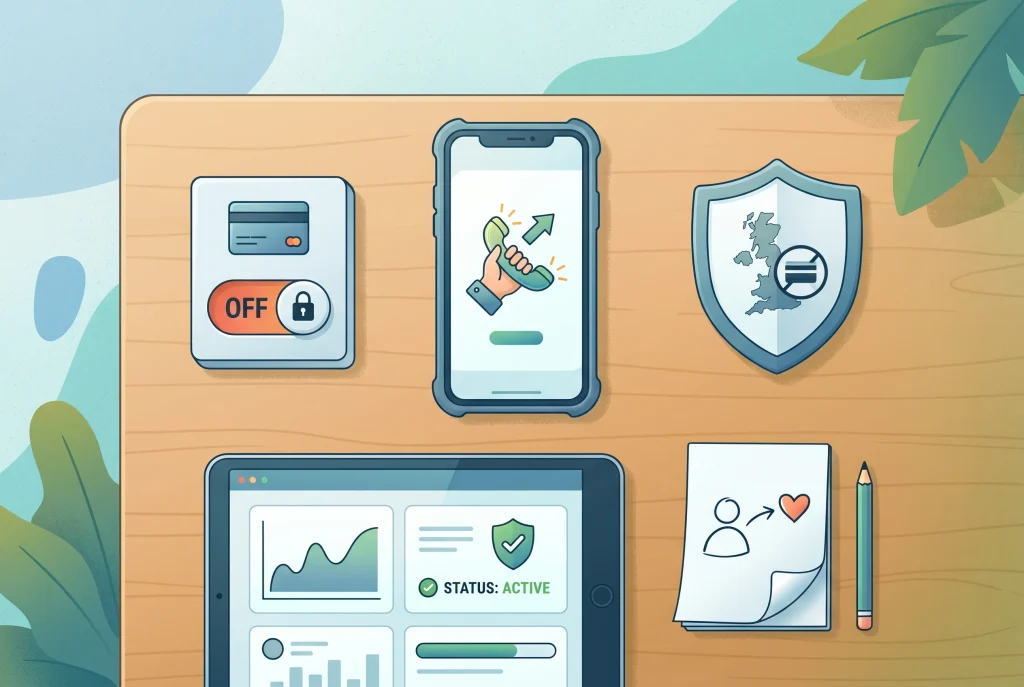
Looking for a way to gamble despite a block, self-exclusion or payment barrier can be a stressful moment. It may feel like the immediate problem is access, but the more important problem is often pressure: pressure to win money back, pressure to keep a habit hidden, or pressure to act before a calmer decision can return.
This page is for that moment. It explains support routes and practical controls without judgement. It does not diagnose anyone, promise a treatment result or describe ways to remove safeguards. The aim is to make the next step safer: pause, speak to a support service, strengthen the barriers that already exist, and protect money and documents while the urge is strongest.
The wider picture is in our guide to what UK players should check.
When to use support before another gambling decision
You do not need to prove that things are “bad enough” before asking for help. Official health information describes gambling problems as something that can affect health, relationships and finances. That can show up in ordinary, practical ways: gambling after setting a limit, hiding payments, using borrowed money, chasing losses, arguing about gambling, or feeling anxious until the next deposit is made.
Support is also relevant when a protection is already in place and you are tempted to work around it. If you have registered with GAMSTOP, switched on a bank gambling block, installed blocking software, or asked someone else to help you control access, those steps were likely taken for a reason. The urge to get past them does not make them useless. It often means they are doing the job they were meant to do.
A safer next step can be small. Do not deposit. Put distance between yourself and the device or payment method. Contact a support service. Tell a trusted person if that is safe for you. Keep account blocks in place while the strongest urge passes.
Recognised support and control options
| Option | What it can help with | How to use it safely | What not to expect |
|---|---|---|---|
| GamCare and the National Gambling Helpline | Free support for people affected by gambling harms in Great Britain. Official safer-gambling information lists the helpline number as 0808 8020 133. | Use it when you feel pulled towards gambling, worried about money, or unsure how to strengthen controls. | Do not treat a helpline as a shortcut to recover gambling losses or settle an operator dispute. |
| NHS gambling information | Health information, self-check prompts and routes to gambling support services. | Use it when gambling is affecting sleep, relationships, mental health, debt or day-to-day decisions. | Do not use public information as a personal diagnosis. |
| GAMSTOP | Online self-exclusion from participating remote gambling businesses licensed in Great Britain. | Use it as a protective boundary and read what it covers before relying on it alone. | Do not expect it to block every gambling service worldwide. |
| Blocking software | Extra barriers on devices and browsers to reduce access to gambling sites. | Use it with self-exclusion and bank blocks, especially where more than one device is involved. | Do not assume software removes every possible route or replaces human support. |
| Bank gambling blocks | Payment barriers on cards or bank accounts that can reduce gambling spend. | Switch them on through your bank’s official channels and keep them in place during high-pressure periods. | Do not treat a block as a problem to get around. |
| TalkBanStop-style layered support | A combined approach using support, blocking software and self-exclusion resources. | Use the layers together so one weak moment does not depend on a single barrier. | Do not expect one tool to do everything on its own. |
A calm next-step checklist when gambling feels hard to stop
- Pause before any deposit, account opening or document upload. The pause is a safety action, not a failure.
- Contact a support service such as GamCare or the National Gambling Helpline if the urge feels strong or repeated.
- Keep GAMSTOP and existing self-exclusion arrangements in place. Do not look for sites specifically because they sit outside those protections.
- Use blocking software and bank gambling blocks as additional layers rather than alternatives to each other.
- Move payment cards, banking apps or gambling emails out of easy reach while the urge is strongest.
- Protect identity documents and passwords. Do not upload documents to a site you have not checked carefully.
- Speak to a trusted person if that is safe. A simple message such as “I need help not gambling today” can be enough to break the immediate loop.
The point of the checklist is not to make a perfect long-term plan in one sitting. It is to make the next hour safer. A good support step is often practical, short and repeatable.
How layers work together
Self-exclusion, bank blocks, blocking software and support conversations each solve a different part of the problem. Self-exclusion reduces access to participating licensed online gambling businesses. A bank block can interrupt payment. Blocking software can reduce site access on devices. A support conversation can help with urges, shame, money pressure and planning. None of those layers is perfect by itself, but together they make impulsive gambling harder.
Do not wait until a tool fails before adding another layer. If you have already used one protection and are still searching for gambling access, add support and another barrier. If you are worried about documents, move to the data safety guide. If a payment problem is pulling you into another deposit, use the payments guide to slow down the money decision and keep bank blocks active.
Layering also helps when gambling affects someone else in the household. A partner, friend or family member may not need to manage every detail, but they can help keep cards away during high-risk times, support a call, or encourage the use of blocking tools. Only involve someone if it is safe and appropriate for your situation.
If a site, bonus or withdrawal is pulling you back
A gambling site can feel especially hard to walk away from when money is stuck, a promotion is active or a withdrawal is delayed. That pressure is real, but more gambling is rarely the cleanest way to solve an account issue. If a withdrawal is delayed, keep records and use the complaint route. If a bonus feels irresistible, read the terms and ask whether the offer is pushing you past a limit you set earlier. If a site asks for documents, protect your identity before uploading anything.
Support and complaint handling can happen at the same time. You can contact a helpline while keeping records of a withdrawal dispute. You can keep a bank block active while asking an operator for the reason a payment is delayed. You can choose not to accept a promotion while still reading the terms calmly. None of these steps weakens a legitimate complaint. They help stop one account problem becoming a new gambling problem.
What not to do when control feels thin
- Do not use false details, someone else’s payment method or altered documents to open or maintain an account.
- Do not remove a bank gambling block during a high-pressure moment just because a deposit feels urgent.
- Do not look for a gambling site because it appears to sit outside GAMSTOP or another protection you chose.
- Do not borrow money to continue gambling or to chase a withdrawal dispute.
- Do not send identity documents to a site that has not been checked through official licence and security steps.
- Do not treat shame as a reason to stay silent. Support services are there for people affected by gambling harms, including people who feel embarrassed or conflicted.
A safer step can feel less exciting than a deposit, but it gives back control. If you are reading this while under pressure, choose one barrier to keep, one person or service to contact, and one payment action not to take today.
The formal protection scheme is explained in GAMSTOP and self-exclusion.
Read next
- What GAMSTOP self-exclusion covers
- Bank gambling blocks and payment risk
- Protect documents if a site looks suspicious
- Withdrawal delays without depositing again
- Back to the main guide