
How to check a gambling site’s licence before sending money
 Available in GB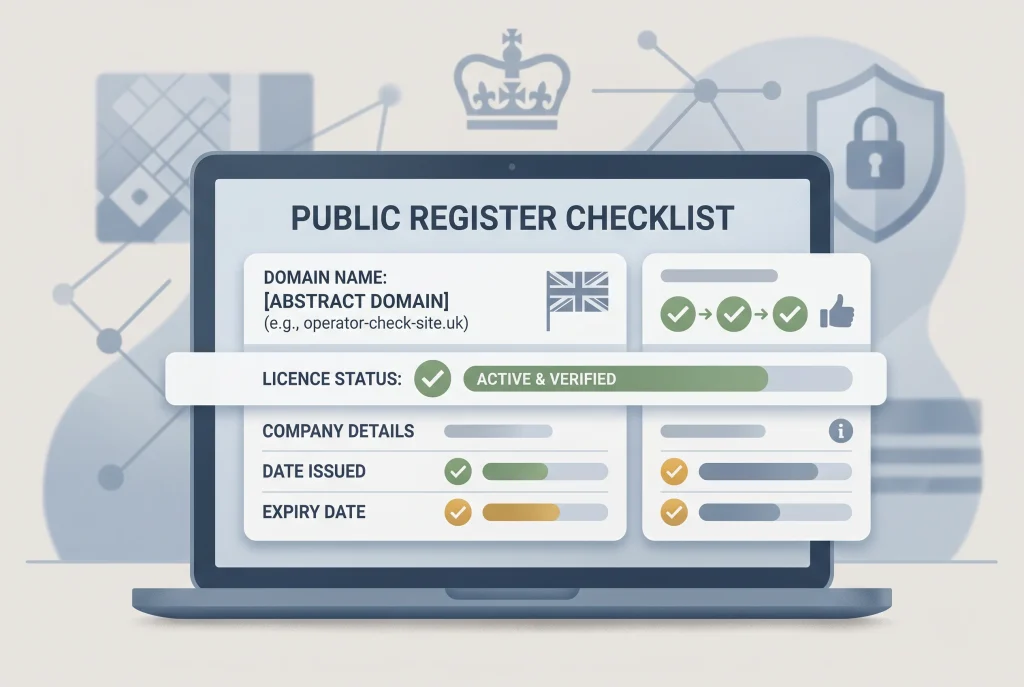
Licence claims can look reassuring, especially when a website uses official-sounding wording or displays a badge. The safer approach is to verify the claim yourself before sending money, opening an account in a hurry, or uploading identity documents. For a person in Great Britain, the key official place to check is the Gambling Commission public register.
This page explains what to compare and what a mismatch may mean. It does not decide whether a named website is lawful, does not recommend gambling businesses, and does not treat a foreign licence as the same thing as a British Gambling Commission licence. The aim is to slow the decision down until the basic public information makes sense.
The wider picture is in our guide to what UK players should check.
Why the Great Britain licence question matters
Commercial remote gambling offered to Great Britain consumers generally requires a Gambling Commission operating licence unless a valid exemption applies. Gambling Commission guidance also explains that a licence issued in another country does not by itself permit a business to provide gambling to consumers in Great Britain. That distinction matters because “licensed somewhere” is not the same as “licensed for the British market”.
The word “UK” is often used casually, but gambling regulation needs more care. The Gambling Commission regulates most commercial gambling in Great Britain, which means England, Scotland and Wales. Northern Ireland is not always covered by the same wording. When checking a website aimed at a Great Britain consumer, use Great Britain language and Gambling Commission checks rather than relying on broad marketing labels.
A licence check is not a quality award. It does not prove that a site is enjoyable, suitable, affordable, fast at withdrawals or free from risk. It answers a narrower question: does the public information support the claim that this business has the relevant British gambling licence, and do the details on the website match what is shown officially?
Start with the public register, not with the badge
The Gambling Commission public register can be used to look up business names, trading names, domain names and account numbers. That matters because gambling websites sometimes present a brand name, while the licence may sit under a different company name. A badge or footer line is only useful if it leads to details you can compare.
Before depositing, write down the website domain, the brand or trading name, any company name shown in the footer, and any licence or account number displayed. Then compare those items with the public register. Do not rely on the presence of a logo alone. Do not assume that a similar name is close enough. Do not treat a broken link, vague wording or missing domain as a small technical issue if you are about to send money or documents.
Licensed gambling businesses should display licensing status and link to the public register. If the link is absent, unclear, or leads to details that do not match the site you are viewing, stop and check carefully. The safest time to notice a mismatch is before your payment details, personal details or identity documents have been shared.
Checklist: what to compare before depositing
| What to check | Where to check it | What a mismatch can mean | What not to assume |
|---|---|---|---|
| Licence status | The Gambling Commission public register entry for the business. | The business may not be licensed for the activity you are being offered, or the site may be using unclear wording. | Do not assume a licence exists because a site uses official-looking language. |
| Domain name | The domain details shown on the register and the exact address in your browser. | The site you are viewing may not be the same domain as the licensed business has listed. | Do not assume a similar spelling, subdomain or copied footer is enough. |
| Trading name and company name | The website footer, terms, account pages and the register entry. | A brand may be operated by a different company, or the claim may not connect cleanly to the site. | Do not assume a brand name alone identifies the licensed entity. |
| Licensed activity | The activities shown on the public register. | The business may have permission for some gambling activities but not for the activity promoted on the page you are using. | Do not assume all gambling products are covered by one general label. |
| Regulatory action where shown | The public register and Gambling Commission notices where available. | Past action may raise questions that need careful reading before money is sent. | Do not treat the absence or presence of one item as a complete safety verdict. |
| Terms link and complaints route | The site’s terms, complaints page and footer information. | Unclear terms or missing complaint information can make problems harder to resolve later. | Do not assume customer support will fix an issue if the basic route is not visible. |
How to read a foreign licence claim
Some gambling sites describe a licence from another country. That may be a real licence for that jurisdiction, but it does not automatically create the same position for a Great Britain consumer. The practical question remains whether the site has the appropriate Gambling Commission licence for offering remote gambling into the British market.
This is where users can be misled by wording that sounds formal but does not answer the right question. A statement such as “internationally licensed” may still leave out the Great Britain check. A licence number without a register link may be hard to verify. A footer that names a regulator but does not connect to the domain you are using may not give enough confidence to continue.
Do not turn this into an argument with live chat. Ask for the exact licensed entity, the account or licence number where applicable, and the official register entry that connects that entity to the domain. If the answer is vague, rushed or inconsistent, the practical next step is to stop, not to deposit while hoping the details will make sense later.
What to do with the result
If the register details match clearly, you still need to read the terms, bonus restrictions, identity-check rules, customer-funds information and complaint route. A match reduces one kind of avoidable risk, but it does not make gambling risk-free or suitable for every reader. It also does not override self-exclusion, a bank block, affordability concerns or a personal decision to stop.
If the details do not match, do not send money while trying to resolve the uncertainty in your head. Save screenshots of the claim, the domain, the footer and any licence information. Leave the account unfunded. If you have already sent documents or money, the next tasks are different: protect your data, keep records, and use the proper complaint or reporting route where relevant.
If the site asks for identity documents before you can make sense of the licence position, treat that as a point to pause. Verification checks can be normal in regulated gambling, but the identity of the business should be clear before you share sensitive documents. If a document request appears after a withdrawal delay, read the ID and withdrawals page rather than assuming the request is either harmless or fraudulent.
Safety note for self-excluded readers
A licence check is not a way to make gambling appropriate during an active self-exclusion. If you are reading this because you are trying to gamble despite a GAMSTOP exclusion, bank block or account restriction, the most useful next step is support, not a deeper comparison of gambling sites. Blocks are there to reduce harm during moments when a person may feel pulled back towards betting.
You can use the official GAMSTOP pages, GamCare and the National Gambling Helpline for support, and you can add practical controls such as blocking software or a bank gambling block. None of that requires you to explain everything perfectly or wait until the problem feels severe. The earlier the pause happens, the more choices remain open.
Quick decision guide
- Find the business name, trading name, domain and any licence or account number on the gambling site.
- Compare those details with the Gambling Commission public register.
- Check whether the licensed activity and domain match the service you are about to use.
- Read the terms, complaints route and customer-funds information before depositing.
- Stop if the details are vague, inconsistent or depend only on a foreign licence claim.
- Use support first if the reason for checking is pressure to gamble while excluded or blocked.
The best licence check is boring: details match, links work, terms are visible, and there is no pressure to rush. If the check feels confusing, that confusion itself is a reason to pause.
With the licence confirmed, move on to payments, bank blocks and funds.
Read next
- Understand the self-exclusion boundary
- Protect documents and payment details
- What to ask if an account or withdrawal is delayed
- Back to the main guide